TCCTA Messenger
August 2026 - Volume LXIII
|
Executive Director Message |
TCCTA has been an important part of my professional life for many years, and this spring I was given the opportunity to serve our Association in a new capacity. In April, the Executive Committee appointed me as Executive Director. I am deeply honored to serve as only the fifth Executive Director in TCCTA’s nearly 80-year history.
As I begin this role, I am mindful of those who came before me. Executive Directors such as Charles Burnside and Richard Moore devoted decades of service to TCCTA and helped build the organization we inherited. I am proud to stand on the shoulders of those giants, and I hope to provide the same continuity and steady leadership they provided our Association.
But continuity cannot mean standing still.
Growing our membership remains one of my highest priorities, but growth must go hand in hand with value. Our members should see a clear return on their investment in TCCTA through high-quality professional development, strong advocacy, meaningful member benefits, and opportunities to connect with colleagues across the state. A larger and more engaged membership, in turn, expands our ability to provide these services and increases our influence on issues affecting two-year higher education across Texas.
We made significant progress in growing our membership last year, but there is still much work to be done. One of the best ways to grow is by meeting educators where they are. I look forward to visiting institutions across Texas to promote TCCTA, visit with members and campus leaders, and hear directly from the educators we serve. If there is an opportunity for me to visit your institution, please reach out.
Advocacy will be equally important as we prepare for the 90th Texas legislative session. Our Legislative Committee has been actively preparing, and we are developing a legislative bill tracker that will provide members with a centralized resource for following legislation affecting Texas higher education. We will also continue our legislative updates and provide opportunities for members to hear directly from those shaping higher education policy in Texas.
There is much to look forward to during the coming year, including our Fall and Winter Conferences and TCCTA’s 80th Annual Convention in Austin this February. These events provide opportunities not only for professional development, but also for our members to connect with colleagues from across the state and build the relationships that have sustained this Association for generations.
I am grateful to the Executive Committee for entrusting me with this responsibility and to our members for their continued support. TCCTA has accomplished much, but I believe our greatest opportunities still lie ahead.
Thank you,

Will Parent
Executive Director |
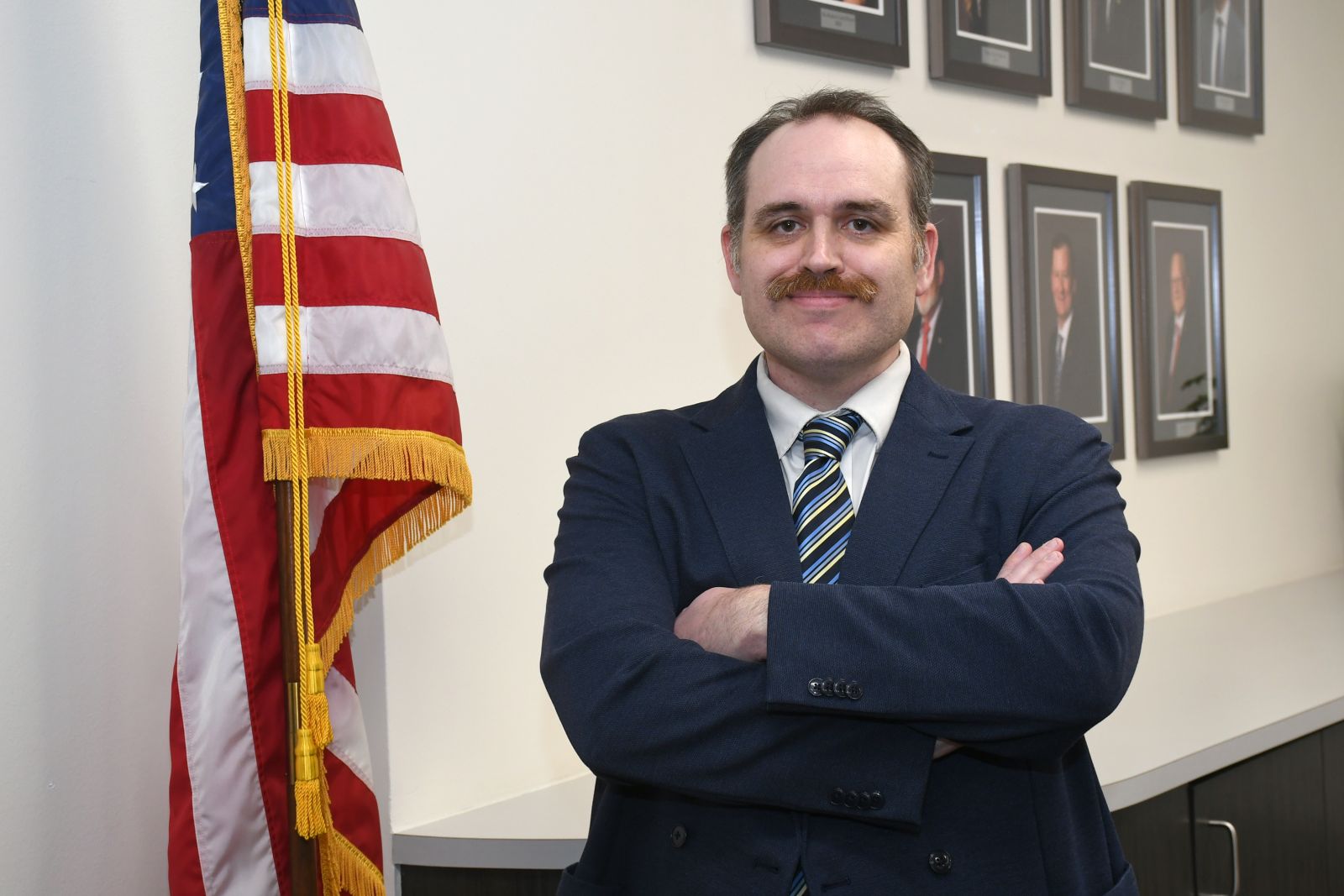
I am Stephen Henry and President of the TCCTA Executive Committee for the 2026-2027 academic year. As a professor of biology at Houston City College, I am preparing for our first day of fall classes like many of you. New students populate our classes with anticipation and returning students renew their commitment to learning. For TCCTA, a similar analogy fits, since August kicks off our critical membership drive where we recruit new members and our nearly 4000 members renew their annual membership.
Why join TCCTA or continue your membership? Our organization’s success and value to its members rests on three pillars: Advocacy, Professional Development, and Networking.
Advocacy is supported by TCCTA with our liability insurance, lobbyist, and TCCTA legislative subcommittee. Please visit our revamped website, online seminars, and conferences to obtain updates and strategies from our lobbyist as we approach the Texas 90th Legislative session in 2027. Obviously, many challenges exist, but TCCTA has a voice in the upcoming legislative session. The good news is that Texas Community Colleges outperformed and exceeded expectations with the outcome-based funding model of House Bill 8. The collective effort of students, faculty, and administrators to increase completion, credentials of value, and transfer rates is outstanding. However, budgetary adjustments are imminent in the Texas 90th Legislative session. Again, advocacy is critical!
TCCTA provides professional development (PD) with our online seminars and events. Sure, you can receive PD at your home campus, but PD with other educators throughout the state of Texas is very robust. My favorite session at our 2026 Convention in Frisco was GIFTS (Great Ideas for Teaching Students). Several speakers at round tables of 8 attendees discussed their approach to artificial intelligence in the classroom. The feedback from those tables was lively and illuminating – the pros and the cons – since AI policy and usage vary at different institutions.
Insofar as networking, we offer online and face-to-face events to meet other educators. Personally, I enjoy meeting other faculty from different colleges in my specific discipline and would like to assemble “affinity groups” in round tables for a session at our 80th TCCTA Convention in Austin. Also, members may benefit from a session of panelists tackling important issues facing community college educators, such as AI, allowing members ample time to ask questions with a flowing discussion.
The health and stability of TCCTA is dependent upon its members. Encourage faculty at your campus to become members and participate in our events. If you have any questions, then please contact the TCCTA State Office. I look forward to meeting you at one of our online conferences or the convention in Austin. Have a splendid and productive semester.
Stephen Henry
TCCTA President |
Top of the Roller Coaster
By Beaman Floyd
As our members prepare to return to the classroom for the Fall semester, the TCCTA state office is preparing for the upcoming 90th Texas Legislative Session. Some may wonder at the sense of urgency, since the session will not begin until the Spring semester starts. However, in the unique rhythm of public affairs in Texas, the ride has already begun. We are nearing the top of the biennial roller-coaster, with the clattering climb about to give way to the deadline-intensive charge to a Memorial Day finish.
In the past several months, TCCTA has been gathering intelligence, identifying public policy issues, and formulating a strategy for the coming session. Thanks to member input from you, we are pursuing policy changes to create more flexibility for hybrid and remote work, roll back some of the changes to faculty senates, and critically examine threats to academic freedom. Each of these issues may take the form of one or multiple bills in the legislative session.
In addition, we are engaging in developing issues related to the core curriculum at public colleges and universities. Currently Texas law requires the Texas Higher Education Coordinating Board to adopt a 42-hour core curriculum for the purpose of encouraging “the transferability of lower division course credit among institutions of higher education (Ch. 61.822, Texas Education Code).” The law related to the core was first passed in 1997, with many amendments being added in succeeding years. Its purpose is to ensure a complete and efficient body of courses that would transfer between institutions. The core has been important for institutional parity and stability, economic efficiency for students, and academic completeness for Texas degrees.
Two issues are emerging related to the core curriculum. The first is whether too many different courses are being offered that count toward the core, and whether such broad offerings are confusing to students and damaging to the idea of a common core education for students. In its July 22nd meeting, the Higher Education Coordinating Board heard a preliminary presentation from staff on this matter, which asserted that there are 3420 unique courses that count toward the 42-hour core. Though the presentation was to provide information only, the clear intimation from staff was that far too many core course offerings were resulting in confusion and inefficiency. Staff did not address reasons for the broad offering, including better pedagogy and the desire to give students content material that they wish to engage while teaching academic fundamentals.
The second issue is whether to reduce the 42-hour requirement itself. So far, this specific issue has not been addressed directly in either in the House and Senate interim charges nor by the Coordinating Board. However, Commissioner Wynn Rosser has made some off-hand comments in public meetings about Texas having the highest number of required core hours. Additionally, on August 13, the University of Texas at Austin released a plan for its core program, narrowing course offerings and reducing core hours to 36, to be implemented in the 2027 and 2028 academic years. Such a plan would potentially require approval by the Coordinating Board and the legislature, and creates a general question about how the UT core would affect transfers from other institutions. In any case, we think it is totally clear that the core curriculum will be a legislative issue in 2027.
For TCCTA members, understanding the important distinctions in arguments related to the core and our other issues are critical to representing ourselves at our institutions and in the state house. We will continue to collect intelligence, engage policymakers, and critique the “rumor mill” to separate unfounded information from real policy initiatives, so that we can get early warning, clarify components of policy issues, and dispense with erroneous information.
We work these tools to prepare for our efforts in the coming legislative session, both to craft reasoned arguments and to maintain strategic communications with policymakers throughout the legislative process, starting now. As always, but with increasing urgency, we urge you to stay up to date on these issues, stay involved with TCCTA, and encourage your colleagues to join your organization. Everybody is going to take this ride, whether they know it or not. We think the faculty of our institutions is better served deciding when and how they will take the roller coaster together, so that maybe they can decide what they get from the ride.
|
🎉 Leading from the Middle 2026
What an incredible success Leading from the Middle 2026 was! Thank you to everyone who attended, presented, and helped make this leadership experience such a memorable event.
Over two inspiring days, community college leaders from across Texas came together to learn, collaborate, share ideas, and build lasting connections. From engaging keynote presentations and interactive breakout sessions to meaningful networking opportunities, the conference was filled with valuable conversations and practical leadership strategies.
A special thank you to our outstanding speakers and sponsors for sharing their time, expertise, and support. Your contributions made this event truly exceptional.
We invite you to relive some of the highlights by browsing our photo gallery below. We hope these photos capture the energy, collaboration, and excitement that made this year's conference so special.
📸 View photos from Leading from the Middle 2026 below!
Thank you to those for being part of the TCCTA community. We look forward to seeing you at future events!
|
Dum Spiro, Spero: Incorporating Latin for Enriched Comprehension
By Kat McMullen, Blinn College
Instructors of all kinds, especially developmental reading and writing instructors, are on a continuous quest to discover better methods to help students with reading comprehension. Clearly, the best solutions are to increase vocabulary and general knowledge, but sometimes it can be difficult to boil these goals down into concrete solutions. One method that has born much fruit in my own classroom is the incorporation of Latin word memorization.
“But Latin is a dead language!” my students protest, that is, until their eyes are opened to some of the ways that Latin has enriched English and many of the Romance languages that they hope to learn one day. Requiring my students to memorize the seventy Latin words that are most commonly found in English cognates has given them the tools to think of words as having distinct histories and to break words apart in order to better decipher meaning. I know that my students gain this understanding because at the end of each semester, they usually say something about the benefit of dissecting words or mention how the Latin memorization in my class helped them in their microbiology, kinesiology, chemistry, and even animal science classes.
But why Latin? I was faced with a dire need to increase student vocabulary as quickly and as efficiently as possible. I was raised in a very strict prep school where I was forced to learn Latin, and though I hated it at the time, it helped me tremendously with my vocabulary. As college instructors, our time is too limited to make up for what might be years of vocabular neglect. However, if we efficiently incorporate Latin, we can exponentially multiply the students’ vocabulary. Sixty percent of English words come from Latin, and any time that our students come across any word that contains one of those Latin roots in the future, it will be a boon to them. What a return on investment!
The way to incorporate this is simple. First, I introduce my students to the idea of Latin as beneficial to their own goals for better vocabulary (many students asked me for advice to improve vocabulary before I added Latin to my curriculum.) I tell my students that when I was a child, my father explained, “English has a German daddy and a French momma. The French momma’s father is Latin.” This is a pretty good explanation of how English came to be such an interesting etymological amalgamation.
Students are given ten Latin words at a time. On the whiteboard, I write the Latin root (that is, the piece of the Latin word that we see inside of English words,) and the original Latin word (in nominative singular case if it is a noun or the infinitive if it is a verb.) Next, I give the students a few cognates (words I know are derived from that Latin root) and take their guesses of other English words that might be cognates. On the overhead screen, we take time to research the etymology of words that might be false cognates. Finally, I have the students analyze the cognates until as a class, we figure out the meaning or translation of the Latin word. It’s actually very fun, and the students gain confidence in their ability to guess word meanings in a safe environment.
The quizzes are done in class on paper, usually at the beginning of a session to encourage timely arrival. The rules for the quizzes are not too difficult; since a vocabulary quiz is not a spelling test, I don’t take off for English cognates that are spelled incorrectly, as long as I can tell what the words are supposed to be. However, the Latin must be spelled correctly or else it will be counted wrong. The quizzes are all fill-in-the-blank because knowing the content is the whole point. Although such hands-on quizzes take time to grade, this is the best method I have been able to come up with so far. I want the students to know the Latin well enough that it comes to them in the future when they need it, and life does not generally provide multiple-choice answers.
There have been several interesting, unanticipated benefits to adding Latin to my course. One is that my students who learned Spanish as their first language are delighted to have an advantage in an English class! Because Spanish is so much closer to Latin than English is, they generally do well on the quizzes, improve their understanding of how to interpret English words, and gain confidence in their writing and speaking as English students.
Another interesting side benefit is that many of my developmental students who come labelled with certain difficulties are nevertheless able to memorize the correct spelling of Latin words and often gain confidence through their success on the quizzes. At first, I was puzzled by why these students spelled Latin correctly but continued to misspell English words. However, when I required out loud reading in my classes, I additionally discovered that many students had not learned phonics and could not sound words out for reading or spelling. The fact that they could memorize the correct spelling of Latin words when required to do so gave me hope that many students can improve their spelling simply by being required to memorize phonics and general English spelling rules. They have what it takes. Additional cursory understanding of the etymology of words as well as phonics and spelling rules for commonly borrowed languages such as French and German would set our students up for spelling and pronunciation success for the rest of their lives.
Latin is a deeply integrated element of our language that is academically underutilized, but using this powerful tool can maximize benefits for reading comprehension. It has made a meaningful difference in my classroom, and I heartily believe that it can make a meaningful difference in your classroom as well. Why not give it a try this semester? Fortes fortuna iuvat! |
TCCTA Vice President Terry Gilmour Earns
APSA Distinguished Teaching Award
By Ashlee Wigham, Director of Membership and Programs, TCCTA
Dr. Terry Gilmour, vice president of the Texas Community College Teachers Association, has been named the recipient of the 2026 American Political Science Association Distinguished Teaching Award.
The national honor recognizes outstanding contributions to undergraduate and graduate political science education at two- and four-year institutions. Gilmour will be recognized during the APSA Awards Reception at the association’s 122nd Annual Meeting and Exhibition in Boston, Massachusetts.
A professor of government and political science at Midland College, Gilmour has dedicated more than three decades to teaching, mentoring and helping students connect classroom lessons with the political world around them. She began teaching at Midland College as a part-time instructor in 1993 and has served as a full-time professor since 1997.
Gilmour’s teaching philosophy centers on making government relevant to students’ lives. By incorporating current events into her courses, she encourages students to see political science not simply as a collection of institutions and theories, but as an active force shaping their communities, state and nation.
Her commitment to student learning extends well beyond the classroom. Gilmour has served as director of Midland College’s Honors Program, advised Phi Theta Kappa students and supported student participation in leadership conferences, academic presentations and community-college advocacy events. She has also mentored students as co-authors of research examining the history, environment and political development of West Texas.
Among her notable educational projects is a series of eight critical-thinking and information-literacy modules developed with Midland College undergraduates Maria Gonzalez, Faith Lopez, Carlos Torres and Elizabeth Whitten. Published through APSA Educate, the modules help students evaluate information and navigate a political-media environment increasingly affected by misinformation.
Gilmour has also provided leadership to the political science profession nationally. She previously served on APSA’s governing council and as president of its Political Science Education section. In 2025, she co-chaired the association’s Teaching and Learning Conference committee. Her service reflects a career-long commitment to strengthening political science instruction and ensuring that community-college educators and students have a voice within the discipline.
The Distinguished Teaching Award is especially meaningful because it honors both sustained excellence and educational work of exceptional impact. Gilmour’s selection recognizes not only her accomplishments as an individual educator, but also the importance of community colleges in preparing informed, thoughtful and engaged citizens.
For TCCTA, Gilmour’s achievement is a proud reflection of the talent and leadership found throughout Texas community colleges. Her recognition on the national stage celebrates a teacher whose influence reaches from individual classrooms in Midland to the broader political science community.
As Gilmour is honored in Boston, the award will mark an important milestone in a career defined by service, innovation and a steadfast belief in the transformative power of teaching.
Sources: American Political Science Association’s 2026 award announcement, Midland College faculty profile, and APSA Educate critical-thinking modules.
|
Leading from the Middle: Leadership in Practice
By Rachel Hunt, Angelina College
Leadership is often associated with titles, but in our community colleges, some of the most impactful leadership happens every day in classrooms, offices, and departments by individuals who choose to mentor others, solve problems, and strengthen their institutions. That is exactly why TCCTA's Leading from the Middle conference is so valuable.
This year's conference brought together professionals from across Texas who share a common commitment to serving students, supporting colleagues, and growing as leaders. Beyond the presentations and discussions, the conference reinforced an important truth: leadership is strengthened through collaboration, shared experiences, and a willingness to learn from one another.
One of the highlights of this year's program was the opportunity to learn from practitioners who are leading in higher education every day. Condoa Parrent of Tarrant County College, Dr. Diana Throckmorton of Angelina College, Lindley Workman Alyea of Texas State University, and Dr. Eric Branscome of Collin College shared practical insights drawn from their professional experiences. Their willingness to share both successes and challenges provided meaningful takeaways for participants and demonstrated the value of higher education leadership grounded in real-world practice.
I would also like to express my sincere appreciation to the TCCTA state office for the tremendous work behind the scenes. Thank you to Will Parent, Executive Director; Ashlee Wigham, Director of Membership & Programs; and Clay Jackson, Director of Development & Operations, whose planning, organization, and dedication made this conference a success. Their commitment to providing high-quality professional development opportunities continues to strengthen our association and support community college professionals across Texas.
Congratulations to Donna Godwin, Candice Edmonston, Dana Curry, Kecia Baker-Morris, and J. Keith Baker, the winners of this year's conference raffle. Each received registration to TCCTA's 80th Annual Convention, February 3–5, 2027, at the Renaissance Austin Hotel. I hope to see many of you there as we celebrate eight decades of advocacy, professional development, and service to Texas community colleges.
It is an honor to serve as TCCTA's President-Elect and to be part of an organization committed to developing leaders at every level. Whether you are new to higher education or have served for many years, each of us has opportunities to lead, encourage others, and make a lasting difference.
Thank you to everyone who participated in Leading from the Middle 2026. I look forward to continuing our work together and seeing you in Austin this February! |
Take a look below and on our calendar or events for recent highlights and upcoming TCCTA events. Scroll to the bottom of the calendar link on tccta.org and subscribe to the TCCTA calendar to stay in the know! |
|
Information about Fall Conference:
This Fall Conference offers a full day of insightful discussions and —tailored to navigating the fast-changing educational environment. It’s virtual, affordable, and packed with relevant content.
When: Saturday, September 12, 2026
Time: 9:00am - 3:00pm
Members: $50
Non-Members:$100
*All sessions will be recorded and made available to registered attendees for later viewing at no additional cost. |
|
Information about Winter Conference:
This Fall Conference offers a full day of insightful discussions and —tailored to navigating the fast-changing educational environment. It’s virtual, affordable, and packed with relevant content.
When: Saturday, November 14, 2026
Time: 9:00am - 3:00pm
Members: $50
Non-Members:$100
*All sessions will be recorded and made available to registered attendees for later viewing at no additional cost. |
|
Join us as we celebrate a remarkable milestone—TCCTA's 80th Annual Convention, taking place February 3–5, 2027, at the beautiful Renaissance Austin Hotel in Austin, Texas!
This special anniversary convention will bring together community college educators, administrators, and professionals from across Texas for three days of inspiring keynote speakers, engaging breakout sessions, innovative ideas, valuable networking, and professional growth. Whether you're looking to discover the latest trends in higher education, connect with colleagues, or gain practical strategies to take back to your campus, the Annual Convention has something for everyone.
Don't miss this opportunity to celebrate 80 years of supporting Texas community colleges while helping shape the future of higher education.
On Wednesday evening, join us for the TCCTA Banquet Dinner, a highlight of the convention where we celebrate excellence, community, and achievement. Enjoy a night of great food, inspiring company, and celebration — all in the heart of Austin’s lively and welcoming atmosphere.
Banquet tickets are INCLUDED with every ticket!
Registration is OPEN—we can't wait to see you in Austin!
Questions about Direct Billing and/or Group registration? Please e-mail: awigham@tccta.org |
|
2026-2027 Faculty Fellows Program
Are you in your first five years of teaching and ready to grow as a leader? TCCTA’s Faculty Fellows program helps emerging community college faculty build confidence, develop leadership skills, connect with colleagues across Texas, and explore important issues shaping higher education. Participants receive specialized leadership development, a legislative briefing, conversations with statewide education leaders, TCCTA membership, and registration for the Annual Convention.
Colleges may nominate up to two promising faculty members. Learn more about Faculty Fellows or complete the enrollment form. |
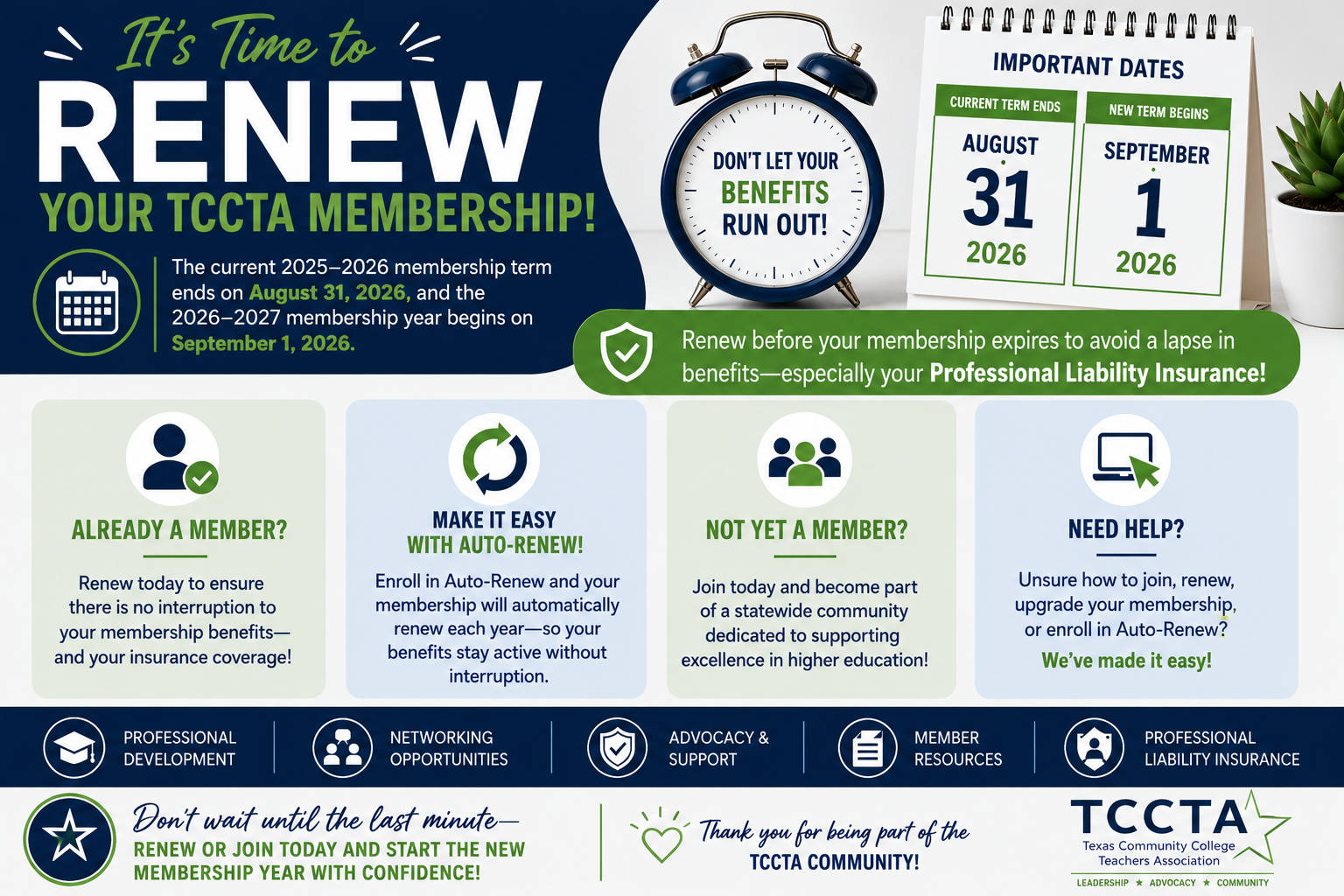
🔔 It's Time to Renew Your TCCTA Membership!
The current 2025–2026 TCCTA membership term ends on August 31, 2026, and the 2026–2027 membership year begins on September 1, 2026.
To continue enjoying all the benefits of TCCTA—including professional development opportunities, member resources, networking, advocacy, and exclusive communications—be sure to renew your membership before the new term begins.
✅ Already a Member?
Renew today to ensure there is no interruption to your membership benefits. If you have Professional Liability Insurance as part of your membership, renewing before your current membership expires is especially important to help avoid a lapse in your insurance coverage.
🔄 Make It Easy with Auto-Renew
Take one more thing off your to-do list by enrolling in Auto-Renew. Your membership will automatically renew each year, helping ensure your membership—and any Professional Liability Insurance coverage you carry through TCCTA—remains active without interruption.
🌟 Not Yet a Member?
There's never been a better time to join! Become part of a statewide community of community college educators and leaders dedicated to supporting excellence in higher education. As a TCCTA member, you'll gain access to valuable professional development, advocacy, networking opportunities, exclusive member communications, and optional Professional Liability Insurance coverage.
❓Need Help?
Unsure how to join, renew, upgrade your membership, or enroll in Auto-Renew? We've made it easy! Visit our step-by-step guide here: https://tccta.org/tccta-how-to-videos/
If you still have questions, we're happy to help—just reach out to the TCCTA office.
Don't wait until the last minute—renew or join today and start the new membership year with confidence! |
 |
| A special thank-you to our members for shining as the stars of our new video! |
|
Classical Kindness in the Classroom
By Erin Hill, Blinn College
The blockbuster hit of the summer is Christopher Nolan’s The Odyssey. It has already earned nearly $300 million at the U.S. box office and $650 million globally. The New York Times reported that book sales of Homer’s epic have increased by 76% because of the release of the film as well. People are watching, reading, talking, and posting about the epic tale non-stop, and teachers and classics lovers everywhere are thrilled.
One ancient concept prominently featured in the three-hour long film is xenia, which means hospitality. (Xenophobia is an etymological cousin we might recognize.) This concept of xenia, referred to as Zeus’s law in the movie, was a sacred rule of hospitality that required hosts to welcome travelers and strangers, to feed and house them, because they might be gods in disguise. Guests, too, were expected to show appreciation and to refrain from disrespect or theft.
Suffice it to say, Odysseus both breaks and follows the custom of xenia, of Zeus’s law. The film is an exploration of what happens both to him and the world he inhabits when adherence to Zeus’s law comes apart. And I left the movie theater thinking about the power of such customs in our world and specifically in the world of education.
It’s not always easy to consider every one of our students as a distinct, unique individual, especially not when we’re teaching four or five classes, designing multiple preps, or grading dozens of essays. But applying xenia in our professional lives can make a difference, both to us and to our students.
Last year, I had the chance to step up and help another student, a young man who had just finished writing a blue book essay for my English 1301 final and was on my mind because I had just opened the essay to grade.
In the first part of the essay, he disclosed that he was on the autism spectrum, which I had suspected but had not known definitively, and then shared that the past semester had left him feeling defeated and unsure about his ability to be a college student.
Reading these words hurt my heart because I wanted him to be successful but also saw the wide gulf between the level of literacy required to successfully complete Composition I and his skillset. My class wasn't the first time he had taken Comp I and it probably wouldn’t be the last time. And that was really painful for him, and also painful for me.
So I was already feeling my feelings when I read an email from him, sent at around 10:45 a.m. from the student center one building over.
"Thank you for a fun semester. But today is a really bad day," he wrote to me. "I'm not having a good day at all."
I read that and felt sad about the academic stuff, assuming that he was referring to grades, but kept reading and saw that he had another more pressing concern.
"The food court is closed so I won't have any lunch. No lunch for me today, I guess."
I knew that he was typically on campus until the very end of the workday when his mom picked him up after she left her job. Most days, he spent the afternoon relaxing in the student center, eating a packed lunch or something from the food counter while he watched favorite movies on his tablet, but today, strangely, the little store and cafeteria line were shuttered.
I responded with a suggestion to walk a couple of blocks over to a nearby Burger King and tried to explain carefully where to find the crosswalk and how to avoid traffic, but knew that even with my instructions, crossing a major road would feel too daunting and unfamiliar to him.
"I do wish I could go there," he emailed back. "I just don't feel safe with shootings and violence. I don't feel like I can do that. It's okay, I will just not think about lunch. It's just not a good day today."
I could imagine my own son, also on the spectrum, feeling the same nervous way about trying to navigate city streets by foot when he was younger and knew that for this young man, his day could go from bad to much, much worse with the specter of hunger and deprivation hanging over him.
So I quickly typed a response: "Would you like a steak fingers or chicken fingers meal basket from Dairy Queen? I have to run an errand, and I will gladly grab you some lunch while I'm off campus."
"Really, are you sure?" he responded with lightning speed. "I have my card. Should I give that to you? And could I have a Coke please?"
So twenty minutes later, I'd zipped over to the DQ, grabbed a meal and a Coke for him, and delivered it to the student center where he was passing the time in a dark, mostly empty room.
He saw me coming and actually met me at the building entrance and held the glass door open for me, leaning into the heavy spring with his shoulder, as though he were the host welcoming an honored guest, me, to a special dinner.
"Do you need my debit card?" he asked again, insisting that he wasn’t trying to take advantage of me.
"No way," I said with a big smile. "My treat. I definitely don't want you to be hungry all afternoon!"
"Me neither," he said and grinned. "And thank you so much, Mrs. Hill." Then he pulled the lunch box close to his chest and breathed in deeply: “Maybe today won’t be so bad after all.”
I know he appreciated that lunch and had a better afternoon because he wasn’t worried about a meal, but I also appreciated the chance to help him and to think about something other than essays or grades or scores. It was a momentary reminder of what’s truly important in our work: the people. And I’m going to try to look for more xenial moments like that one during the upcoming semester. |
|
As your August renewal approaches, I wanted to flag a new student option that's available on the contract: Adobe Acrobat Express, a hybrid of Acrobat on the web and Adobe Express Premium, with Firefly generative AI.
We see this as a critical piece for preparing your students for the jobs of the future. It puts real AI-powered creative and document tools directly in students' hands, the same kind of tools employers are looking for right now – and say students are showing up unprepared for!
A few resources if you want context on why this matters for campus AI strategy more broadly include:
Please direct any inquiries to Julie.
Julie Persin (she/her)
Adobe Senior Enterprise AI Sales Specialist, EDU
C 415 572 1876
jpersin@adobe.com
|
|
|






.jpeg)



.jpeg)