But first, you likely know that finding an accurate diagnosis can take years. This delay can cause missed treatment opportunities, worsen your health outcome, and increase your medical costs. But could there be a solution on the horizon?
Let’s dive in.
Could AI End Years of Autoimmune Misdiagnosis?
Chances are, you either have an autoimmune disease or know someone who does. These conditions are so common that you’d think a clinician would be able to sniff out an accurate diagnosis from a mile away. Unfortunately, that’s far from true.
The reality is, these conditions are challenging to diagnose due to overlapping symptoms like fatigue and brain fog, poorly understood disease mechanisms, lack of standardized tests, and limited awareness among healthcare providers. But what if there was a way to take the guesswork out of diagnosing these conditions?
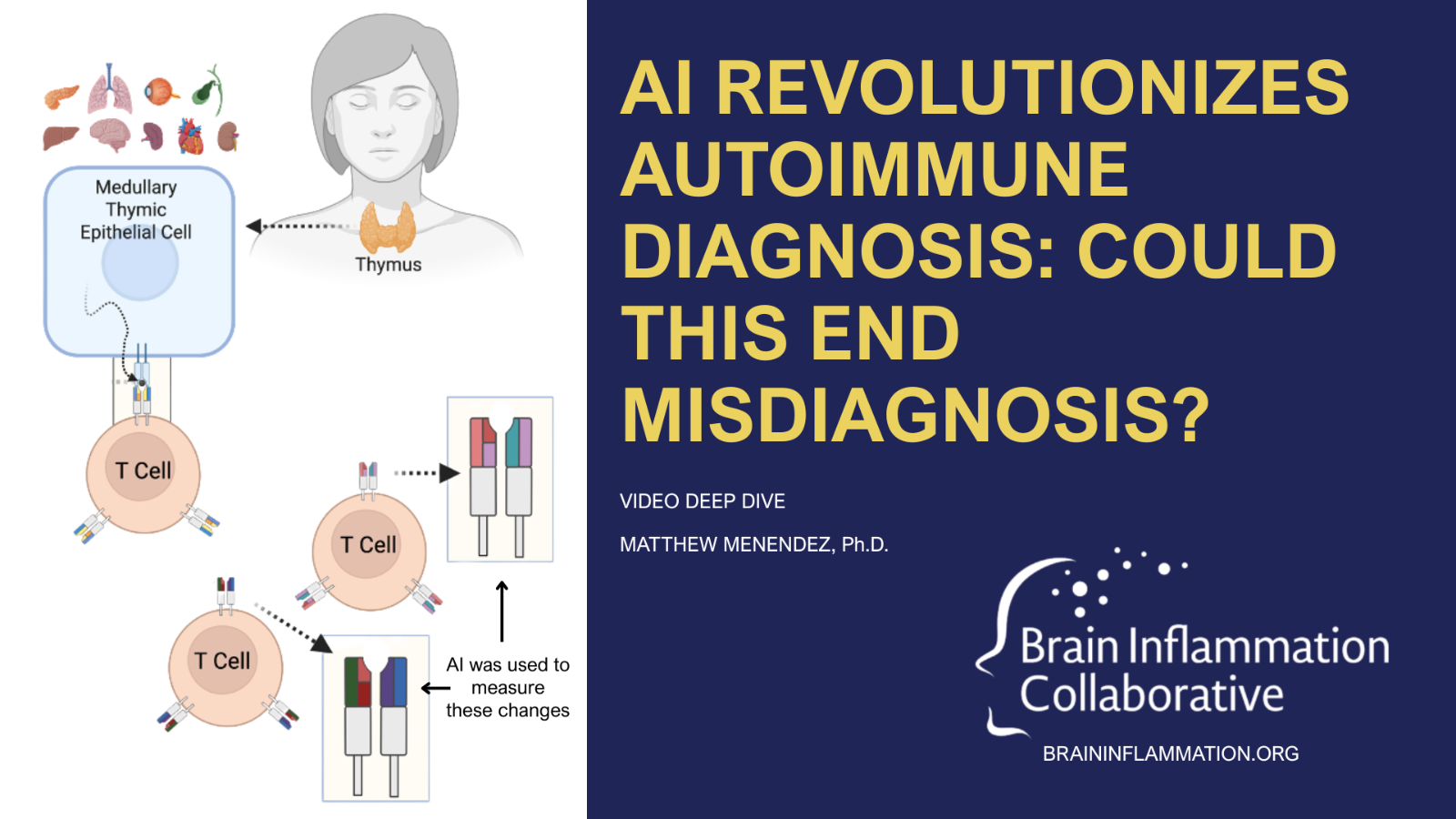
Our latest video dives into a groundbreaking new AI-driven technology from Stanford University that could significantly reduce the rate of autoimmune disease misdiagnosis. Here is how.
Two white blood cell genes, the B cell receptor and the T cell receptor, were collected and sequenced from study participants known to have a specific autoimmune disease. These genes, however, are different than other genes in your body. They have a license to change at will. They shuffle around different DNA segments to make a wide variety of unique receptors, each one capable of protecting you from a pathogen (or targeting your self-tissue, in other words, autoimmunity). This is why AI was needed. The many thousands of unique receptor sequences were used to train AI to predict the immunological status of a different set of participants with the same autoimmune conditions. The researchers reported a 99% sensitivity and specificity.
Share what you enjoyed and any suggestions for improvement by leaving a comment on YouTube. Your input will help us create better videos for you!
Infections and Your Child’s Mental Health: A Personal Journey
Navigating your child’s health struggles can feel overwhelming, especially when answers are hard to find. Christy Jagdfeld, co-founder of the Brain Inflammation Collaborative, knows this struggle firsthand. “I slept little and spent late nights researching, working through the logistics of doctor appointments, and navigating health insurance approvals,” she recalls.
Her daughter faced repeated infections—ear infections, strep throat, even a dental abscess—that seemed minor at the time, but eventually led to a “crash course in neuroinflammation” by age 10. Symptoms like OCD, anxiety, and autonomic issues emerged, yet finding knowledgeable doctors was a battle. “We were lucky—it took us less than the average of 4 to 5 years for most families to get an accurate diagnosis,” Christy shares.
Her daughter's various diagnoses occurred more quickly than most due to diligent notekeeping. “I tried to ignore the eye rolling that clinicians gave us as we entered the room with my very large binder of papers.” Her journey to find answers was not only met with awkward stares, but frustration from doctors: “I had two doctors raise their voices with me, frustrated with my questions and with the information I found online.”
Her and her daughter’s painstaking journey to find answers was so daunting that Christy decided to start the Brain Inflammation Collaborative. “It is my hope that through the research and advocacy work of the Brain Inflammation Collaborative, we can keep pushing the awareness because many clinicians and families simply aren’t aware.”
The Brain Inflammation Collaborative and Solve M.E. Partnership Launches The Unified Platform to Advance Research Across 30+ Chronic Conditions
The Brain Inflammation Collaborative (BIC), in partnership with Solve M.E., is excited to announce the launch of the unhide® Solve Together Unified Platform, a digital health tool designed to uncover hidden connections between inflammation, chronic illness, and overall health.
“We created this platform to empower patients while accelerating research,” said BIC Leaders. “Together, we’re breaking down silos between diseases like ME/CFS, Long COVID, autoimmune disorders, and mental health—linking them through the common thread of inflammation.”
The Unified Platform enables patients and caregivers to:
Track symptoms and visualize health patterns over time
Connect wearable data for more complete insights
Download and print customized reports to have better conversations with healthcare providers
Contribute to cross-disease research initiatives
Optionally receive invitations to participate in clinical trials and studies
Identify ways to determine relationships between brain inflammation and mental health symptoms such as brain fog, difficulty concentrating, memory issues, sleep problems, mood changes, anxiety, and depression
We believe that understanding the new science behind chronic conditions like autoimmune diseases can provide hope, reminding you that many talented people are diligently trying to solve the problems faced throughout their healthcare journey.
Please share your thoughts—rate, comment, or leave feedback using the button below and share this newsletter to help others learn this important information!
Sincerely, The Brain Inflammation Collaborative Team