By Jo-Ann Johnston
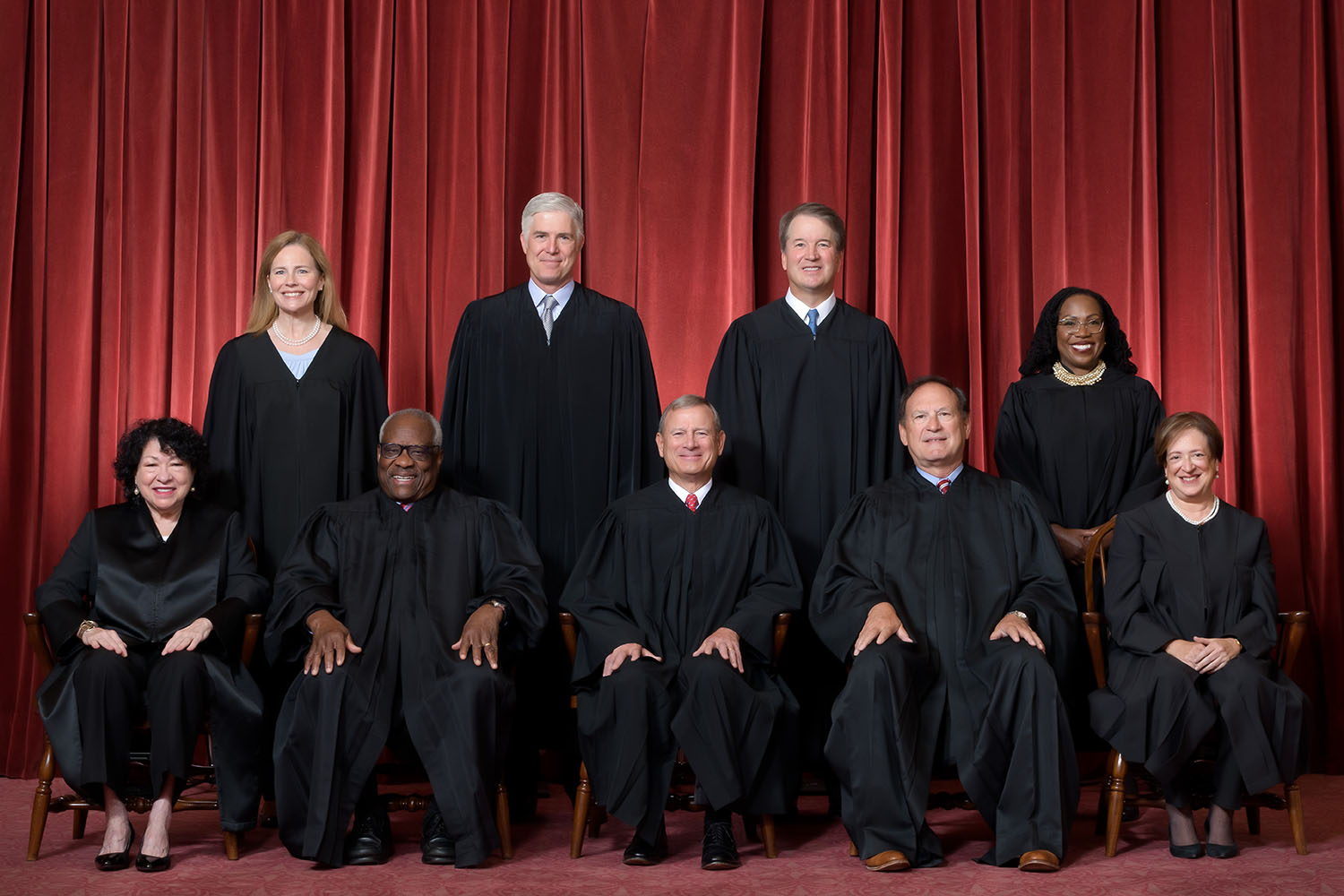
You might have taken note, about three weeks ago, of the first Monday of October. That’s when the nine justices of our Supreme Court reassembled for the first day of their new legal term, which will last until the end of June. During those months, they will typically agree to read briefings and hear oral arguments about influential legal matters that could not be resolved to the satisfaction of the parties involved in the nation’s lower courts.
The 50 to 70 cases accepted for hearing typically involve foundational legal questions of competing or conflicting Constitutional rights. A ruling from the Supreme Court may confirm the correctness of an existing legal standard — or maybe prompt Congress to write a new law.
All that is exciting to legal minds, but not the news demanding attention lately. That news focuses on how the Supreme Court has taken on so many cases that President Trump wants heard quickly, and outside the legal timetable that the Supreme Court has expected most Americans to respect. This isn’t just about noticing a new habit, it turns out.
So. During the 2026-2027 court term, we concerned Americans should be following more closely how many hot-topic political matters make their way to the Supreme Court for review via the court’s emergency docket, sometimes called the shadow docket.
We’ve always had an emergency docket. It has traditionally been used mostly for verifiably urgent, time-pressured situations — say for a request prompted by a turn in a death-penalty case — or for swift resolutions to administrative Supreme Court problems that only the Supreme Court itself can remedy.
Recently, other significant cases, sometimes called merit cases, which would be expected to flow up to the U.S. Supreme Court through the usual application process, have been heard by the high court by getting onto its emergency docket. It’s a little like entering a building by a side door, bypassing a crowded front entrance. The side door, in this case, can be an application made after hours or during court recess.
The justices have mostly tolerated the upturn in emergency applications.
For context, during the 16 years that George W. Bush and Barack Obama administrations were in office, the Republicans and the Democrats successfully used the emergency docket eight (8) times, total. The second Trump administration had applied 34 times by March 2026, a more than fourfold increase over less than two years, according to tracking by the nonpartisan Brennan Center for Justice at New York University School of Law. (1)
Once on the emergency docket, the cases do not trigger the creation of thorough legal background briefs or the high-level oral arguments that the justices ponder in merit cases.
And justices make rulings on emergency applications sometimes without issuing written opinions. Opinions are useful to the country’s legal system because they allow interested attorneys to follow along with the justices’ thinking.
According to critics, all of that diminishes the process of weighing ideas, permits uneven access to the Supreme Court (other merit cases don’t get to jump the line), and lacks customary transparency.
On the flip side, when the Trump administration uses the emergency docket and wins the agreement of most of the Supreme Court — which has a 6-3 conservative majority — it gets to reinforce its new policy changes immediately. Emergency docket rulings upheld the second Trump administration 80 percent of the time in cases presented by March 2026, again according to the nonpartisan Brennan Center. So the administration has won quickly, and often.
There’s more to know. The impact of these rulings is not limited just to the original parties of the underlying case, as with the emergency-docket rulings made in decades past, or perhaps true life-or-death cases that might appear in the current environment.
These contemporary rulings affect wide swaths of the public, such as federal workers who might have been illegally fired, people who might resemble immigrants without papers, and scientific researchers whose Congressionally funded disease studies were cancelled, the Brennan Center noted.(2)
Lives were changed without the passage of pertinent new laws, and without apparent concern for the Constitutionally created duties of Congress to write any new federal laws.
In response, Associate Justice Elana Kagan wrote in 2025: “Our emergency docket should never be used, as it has been this year, to permit what our own precedent bars. Still more, it should not be used, as it also has been, to transfer government authority from Congress to the President, and thus to reshape the Nation’s separation of powers.” (3)
For these reasons, the Brennan Center has recently called on Congress to curb what it calls “abuses” of the emergency docket.
The center’s opinion was included in a wider-ranging policy critique of the Supreme Court. It argues that:
“Congress should pass legislation reforming the shadow docket to prevent future abuse. First, Congress should codify standards to ensure that the Supreme Court takes up a case only when there is a true emergency.” (4)
The Brennan Center document also says:
“Congress should require justices to issue brief written and signed opinions in shadow docket cases, which would provide clarity, increase transparency, and boost confidence in the fair operation of the Supreme Court.“ (5)
We Are NEXT will be watching the Supreme Court and Congress carefully on these matters this term. We’ll also pay attention to the Supreme Court coverage offered by larger newspapers and broadcast organizations this year.
Footnotes
1,2, 4 and 5. Rosenbaum, M. and Whitehead. E. (2026, April 28). “Six Solutions to Fix the Supreme Court,” in Solutions for a Stronger Democracy. Brennan Center for Justice at New York University School of Law. https://www.brennancenter.org/our-work/policy-solutions/six-solutions-fix-supreme-court
3. Kohlberg Center on the U.S. Supreme Court/Brennan Center for Justice. (Published 2025, Oct. 21, and updated 2026, Sept. 29). “Supreme Court Shadow Docket Tracker — Challenges to Trump Administration Actions,” Brennan Center for Justice at New York University School of Law.
https://www.brennancenter.org/our-work/research-reports/supreme-court-shadow-docket-tracker-challenges-trump-administration |