If you're having trouble viewing this email, you cansee it online.
December 4, 2025
USDA launches centralized New World Screwworm website
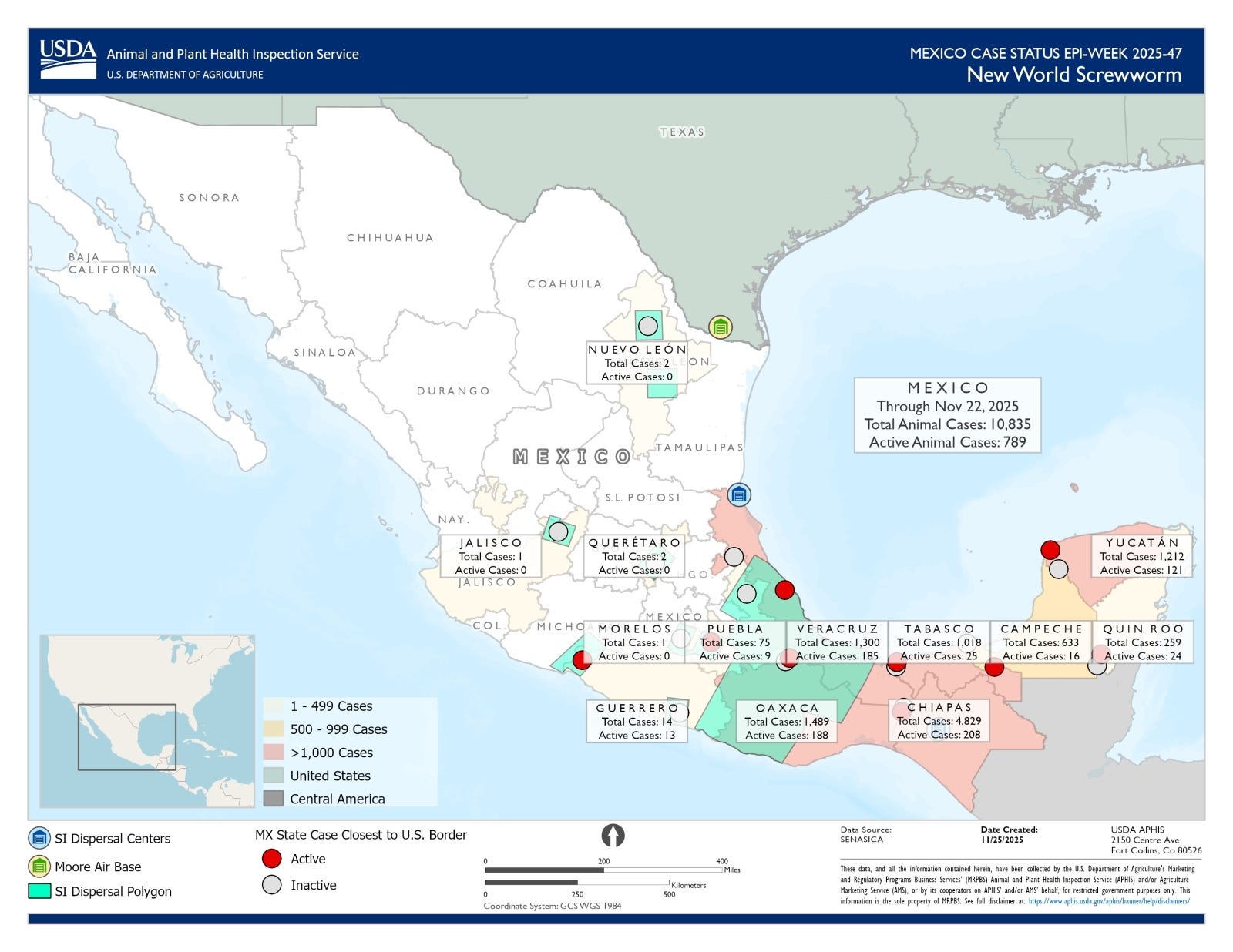
USDA is launching a unified New World Screwworm (NWS) website to centralize information on the government’s “aggressive, whole-of-government response” to the parasitic flies.
While NWS has not crossed into the United States, USDA’s Animal and Plant Health Inspection Service estimates that a contemporary outbreak of the devastating parasitic fly would cost cattle producers $732 million per year in Texas alone, with an overall economic toll of $1.8 billion in the state.
USDA’s Screwworm.gov has targeted resources for a wide range of stakeholders including livestock producers, veterinarians, animal health officials, wildlife professionals, healthcare providers, pet owners, researchers, drug manufacturers, and the general public.
Sterile Fly Production and Dispersal Facilities - Sterile fly production and dispersal efforts are critical to an effective New World screwworm eradication program. USDA is investing significantly to renovate existing and construct new facilities in the United States and Mexico to stop the spread of screwworm.
US Congress members push for full HPAI surveillance -A group of 25 members of the U.S. House of Representatives are urging U.S. Secretary of Agriculture Brooke Rollins to bring surveillance for highly pathogenic avian influenza (HPAI) to “full capacity.”
What’s driving beef and dairy sustainability strategies? - In a newly released report, RaboResearch surveyed over 700 U.S. beef, dairy and crop producers in 2024-2025 to reveal what drives sustainability on farms and ranches. The study seeks to understand what factors influence on-farm decision-making and to support the agrifood value chain in finding common ground on sustainability.
Why Ohio scientists - and some dairy producers - are against legalizing raw milk -Milk is big business in Ohio. It's 11th in the nation for dairy cows. The USDA reports that dairy accounted for over $1.3 billion in production for the state last year, with the industry's farms covering about 13.6 million acres. And gallons of milk people sold to thirsty Ohioans must be pasteurized.
Beef-on-dairy crossbreeding delivers profit boost - Dairy farmers find financial advantage in breeding lower-tier females to beef sires, resulting in calves worth up to $1,000 more at market than purebred dairy calves.
Data modeling drives Texas A&M war on cattle ticks -Texas A&M AgriLife scientists have uncovered new insights into how cattle fever ticks survive and spread across South Texas, revealing hidden refuges that could explain why the pest remains one of the U.S. cattle industry’s greatest threats.
Can a slow-release bolus crack methane reduction for pasture raised cattle? Ruminant BioTech nets $9.5m - New Zealand-based Ruminant BioTech, a startup behind what it claims is the most efficient livestock methane reduction solution for pasture-based cattle—has closed a $17 million NZD ($9.5 million) Series A round as it gears up for launch in 2026. The funding will help the firm commercialize its bolus, which slowly releases a methane inhibitor in the stomach of ruminants over an extended period, enabling sustained methane mitigation in pasture-raised animals.
NIAA's Weekly Bulletin highlights recent animal agriculture topics in the news. The purpose of the Weekly Bulletin is to provide industry headlines to our newsletter subscribers and stakeholders to raise awareness and foster a dialogue about the public conversation regarding animal agriculture. Articles listed in our newsletter do not represent an endorsement from NIAA.
Antimicrobial Use and Stewardship (AUS) is the statewide program intended to promote actions that will slow the development of resistant bacteria associated with livestock and poultry that have negative public and animal health impacts. The program gathers data and develops studies related to medically important antimicrobial sales and usage, livestock management practices, and trends in antibiotic resistance associated with farm animals and animal products.
NIAA is updating the lists of council members. Whether you attend every council meeting or have never attended, please review our council list and check the boxes for each council you are interested in. To review the purpose of each council, please visit our website here.

.png)