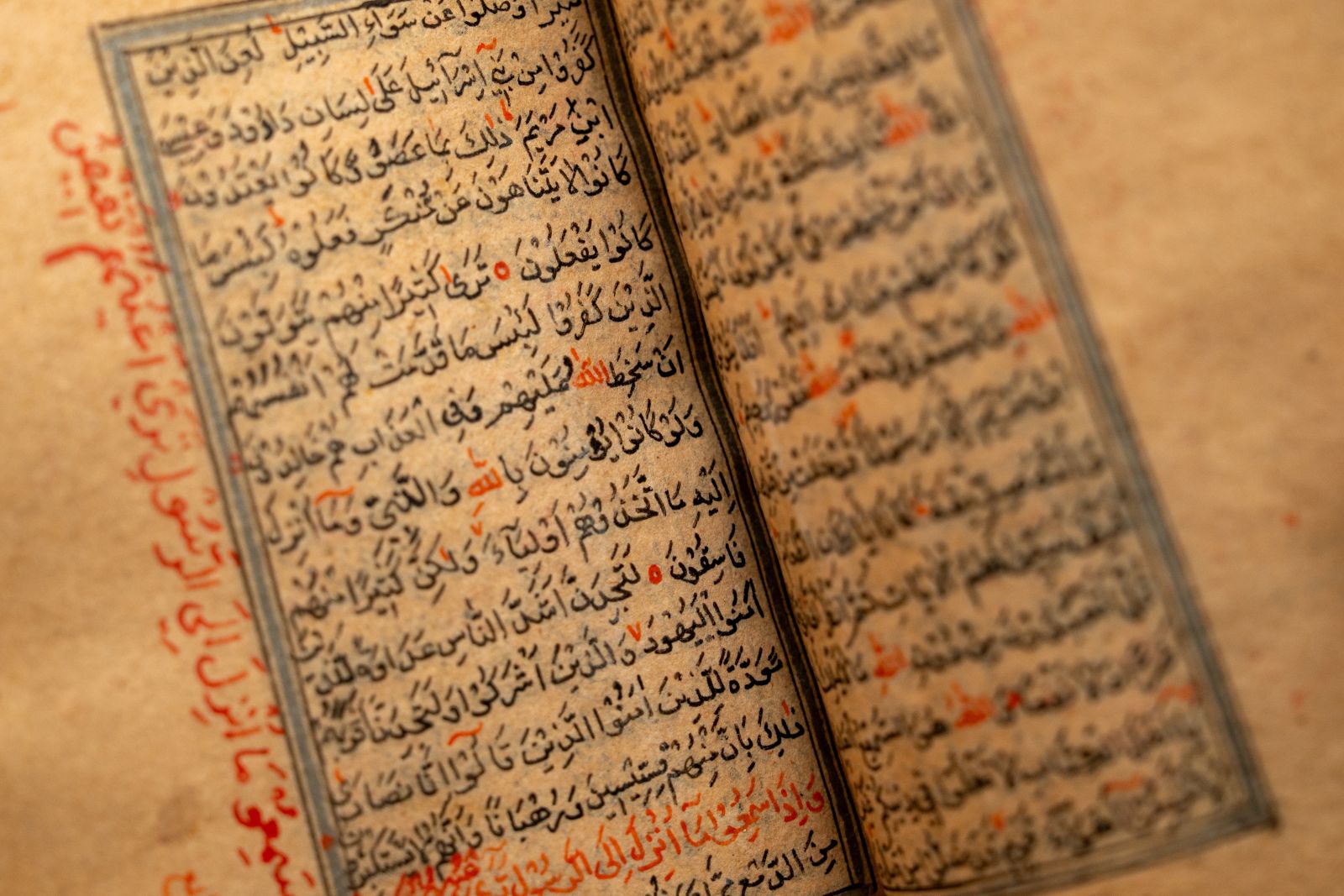
The Historic Qur’an Connecting Zohran Mamdani and Arturo Schomburg
by Hira Ahmed
Photograph courtesy of the New York Public Library
On the midnight of Thursday, January 1st, Zohran Mamdani was sworn in as the mayor of New York City on a copy of the Qur’an from the personal collection of the famous Afro-Latino scholar and bibliophile, Arturo Schomburg, and on loan from the New York Public Library. Hiba Abid, NYPL’s first-ever curator of Islamic Studies, helped Mayor Mamdani’s team select the Qur’an for this occasion, along with her colleagues at the scholar’s namesake Schomburg Center.
Schomburg was a scholar who dedicated his life to documenting evidence of black cultural contributions after a schoolteacher told him there were no significant black cultural or historical figures. Over the course of his life, he collected 4,000 texts, which he eventually sold to the NYPL. Hours before the midnight private inauguration at an old out-of-use subway station under City Hall, Abid spoke to Acacia about the process of choosing Schomburg’s Qur’an for the historic occasion and its symbolic significance.
This interview has been edited for length and clarity.
Hira Ahmed
How did this idea come about?
Hiba Abid
I don't know exactly who on Mamdani’s team came up with this idea, but I know they were exploring meaningful Qur’anic manuscripts in New York collections and, obviously, were interested in the New York Public Library. Rama [Duwaji] has a strong relationship with the Library. She works a few times a week from the Rose Main Reading Room and knows we have this rare collection of New Eastern Islamic manuscripts. So yes, they were interested in exploring possibilities here and finding a meaningful copy from the public library, which reaffirms this idea of accessibility: [it is] a Qur’an and a rare copy that anyone after this historic moment can see, use, and study. So yes, this was really how it began.
Hira
Do you know if there were other Qur'ans in the running?
Hiba
Yes, at the New York Public Library, we looked at a few copies together. Most of them were copies that were very richly illuminated, that seemed to have been produced for important commissioners, so at least patrons and bibliophiles who were able to afford commissioning a copy made with lavish ornamentation, gold, and a diversity of colored inks. Most were Safavid copies, one from Kashmir, rural copies, mainly produced between maybe the 16th and 19th centuries. The bulk of them were housed at the Spencer Collection, and some at the Manchester Archives Division.
But we also included in this selection this Qur’an that belonged to Arturo Schomburg and that lives today in the Schomburg Center for Research and Black Culture, which really stands out because it is not at all a luxury manuscript. It says that it's a very simple one. It's a miniature one in the field of Islamic manuscript studies. We call this a miniature Qur’an because it's a very small one, one that could fit in the palm of the hand. It's a very moving manuscript, and I think they were moved by the intimacy that it conveys, that small script, and it is fully transcribed, written in black ink. So nothing luxurious, just some red ink used to highlight the surahs, and that was it.
Hira
Can you talk about the symbolic significance of using this particular copy of the Qur’an?
Hiba
It's a very symbolic choice because I think it conveys a story about accessibility, representation, and civic-mindedness, since this is the Qur'an from Arturo Schomburg's personal collection. And we know the legacy of Arturo Schomburg during his lifetime, which NYPL carries today: he sold his personal collection to NYPL in 1926, and it became the foundation of what later became the Schomburg Center for Research in Black Culture.
And I think the message here that we could really take is that it's a Qur’an close to the people because of its modest appearance. It looks like it most likely belonged to an ordinary person, and that was meant to be used daily, read daily, and held close to the body. So there is also this very interesting materiality to this object.
The other thing is that it lives in the Schomburg Center. And this is, again, the nation's largest public library system, where anyone can have access to knowledge. There are also other meanings related to faith and identity. It's a very symbolic choice here because the connection to Schomburg echoes the background of Mayor-elect Mamdani, who was born in Uganda, and that came up a lot in his campaign discourse. And the Schomburg Center is devoted to collecting and researching materials from the African diaspora. So it brings together elements of faith, identity, and things that really resonate with New York City.
Hira
The coming together of what you just identified, this Ottoman era Qur’an, owned by an Afro-Latino Nuyorican scholar, that's now being used to swear in the first Muslim mayor. That really captures the diversity people have historically associated with New York.
Hiba
Yes, and when we did a bit of research just to try to understand why Schomburg had a Qur’an in his personal collection. And Barrye Brown, who is the curator for Manuscripts, Archives and the Rare Books Division at Schomburg, did the research, and she found out that there was also an English translation of the Qur’an that he had that also includes a commentary. It includes more context and background on how the text appeared and was revealed, as well as historical and cultural background about the Qur’an. That truly showed that Schomburg was interested in understanding Islam as a living tradition, and he wasn't only interested in acquiring and owning this piece as a physical object. He went beyond that and looked at the meaning of the text and its significance to Muslim people. And because he dedicated his life to collecting materials documenting the African experiences, both in New York and the US, but also in the diaspora and globally, clearly, he considered Islam to be an important component of African culture globally and in the US; he wanted to understand that aspect of the African experience.
Hira
I'm curious. What is the companion piece you're referring to? Is it like a tafsir?
Hiba
Not a tafsir. It's an English translation by a British Orientalist called George Sale. It's an 18th century translation, and that was a very well-known translation, plus a commentary of the text. There were not many translations of the sacred texts that were available during the lifetime of Schomburg, and so he relied on the most well-known of them. And of course, today that translation is obviously outdated and criticized, and it's not really the one we would use today in a scholarly context, but it was often referred to in its time.
Hira
What does it mean for you as the first-ever Islamic Studies curator at the Library that this is going to be prominently displayed in one of the most important buildings in New York City that also happens to be your office?
Hiba
It's a very moving moment for me. We're all witnessing a historic moment in many ways. I really want to invite all New Yorkers to come be a part of that history and learn more about the city's history and NYPL connections, which are very centered on documenting New York life. Beginning January 6th, we will have a public display of this Qur’an [in the Stephen A. Schwarzman Building]. So we really wanted to emphasize the accessibility message again. That's why we call it the people's Qur’an, because it is going to be used in this historic moment, but it's also a Qur’an that anyone can engage with right after that ceremony. Just two floors down, visitors can go and look and learn more about Muslim lives and the Muslim experience in New York through the exhibition [Niyū Yūrk], currently on display.
Beyond that, we're also celebrating the 100-year anniversary of the Schomburg Center. So many far-reaching stories are coming together. I can't tell you how meaningful it is to me, but also to all my colleagues at the Library and the research center.
Hira
What are your hopes for how the public engages with the archive at the NYPL as a result of this historic moment?
Hiba
I hope people will be more aware of these collections and learn more about them. And all of this would be encapsulated in this small format Qur’an in the display case. I hope more people will then learn about Schomburg's legacy, the Schomburg Center for Research in Black Culture's work today, and our Islamic collections, both at SASB and on the flag in the flagship building, and at the Schomburg.
Hira
You're also on the mayor's transition team. Can you talk about the work you've been doing to support public libraries in this role? I know it's still so new.
Hiba
I'm not the only one from a public library and from the New York Public Library involved in these transition committees. Two of my colleagues in different fields and on different committees are also contributing to this effort. It's obviously an honor to be part of the Committee on Arts and Culture, because I was able to bring the voice and perspective of public libraries. Because public libraries have always been a partner to city government, and we really want to continue this fruitful partnership with the new administration. I was very well heard, and I was happy to talk about policy recommendations and what needs to be done for public libraries during this next administration. |