If you're having trouble viewing this email, you cansee it online.
The Contemporary Kaplan Talmud Page
In the very early stages of the digital age (circa 2000) Jonathan Rosen author of the Talmud and the Internet mused:
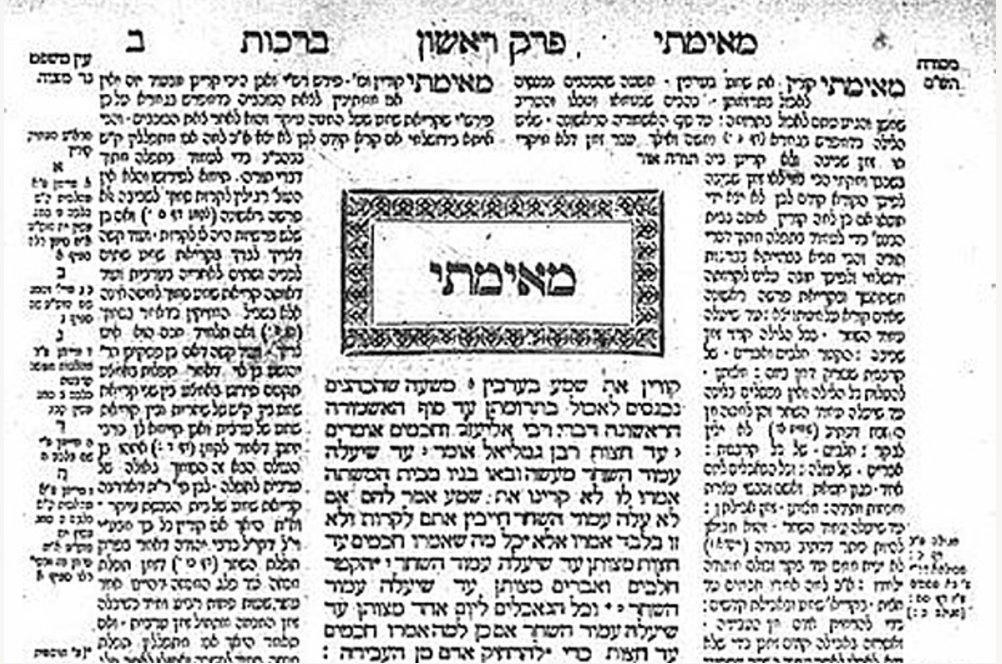
When I look at a page of Talmud * and see all those texts tucked intimately and intrusively onto the same page, like immigrant children sharing a single bed, I do think of the interrupting, jumbled culture of the Internet. For hundreds of years, responsa, questions on virtually every aspect of Jewish life, winged back and forth between scattered Jews and various centers of Talmudic learning. The Internet is also a world of unbounded curiosity of argument and information, where everyone with a mind and modem can wander out of the wilderness for a while, ask a question and receive an answer. I take comfort in thinking that a modern technological medium echoes an ancient one.
At the Kaplan Center, we celebrate this world of “unbounded curiosity” through our Contemporary Kaplan Talmud Pages, dedicated to always digging deeper for the meaning of a core passage from the work of Mordecai Kaplan. The structure of our Talmud page is relatively constant:
At the center, we place a short passage from one of Kaplan’s most important works. This is the Mishna of our work;
We share with three or four great Kaplanian thinkers a set of questions about the text. Their responses become our gemara, filling the page with sometimes differing and sometimes divergent ideas;
Later, we invite other commentators (tosafists) to extend the dialogue.
In this coming year, our two Contemporary Kaplan Talmud pages will be centered on the two major publications of the Kaplan Center of 5786/2025-26: Oneg Shabbat: A Sabbath Evening Table Companion (Sasso and Schein) and The Art of Living: Salvation as Self-Transcendence (Mordecai Kaplan, edited by Richard Hirsh). In past years, we have dealt with such topics as “Who is an educated Jew,” “What is the purpose of Torah,” “Kaplan’s New Zionism,” “Transvaluation” and “Kaplan and Creativity.” The full list can be found hereContemporary Kaplan Talmud.
* Talmud (study) consists of the Mishnah (original text or law) and Gemara, completion of the text. We emphasize the term Talmud (study) because it indicates that Mishnah and Gemara are part of a larger process of expansion of meaning that is fostered by sacred argument. In these contemporary Talmud pages, we use contemporary texts and images as our starting point (Mishnah) and the Gemara is offered by today’s scholars. Our readers are invited to serve as tosafists (commentators) suggesting other points of view.
Hopefully it can help you facilitate even richer Shabbat dinner table experiences in 5787!
Register for Reconstructionist Rabbinical College's Beit Midrash course Conflict and Community in the Ancient Beit Midrash with Rabbi Mira Wasserman, Ph.D. on Thursdays, November 5, 12 and 19 at 7:30-8:45pm EST.
In this three-session online course, Mira will lead close readings of Talmudic narratives exploring how the early Rabbis navigated contention and conflict, from political intrigue and power abuses to conflict resolution and interpersonal reconciliation. Participants will consider what these ancient stories can teach us about building communities across lines of disagreement today.
The mission of the Kaplan Center is to disseminate and promote the thought and writings of Rabbi Mordecai M. Kaplan and to advance the agenda of the Kaplanian approach to Judaism in the 21st century.