If you're having trouble viewing this email, you cansee it online.
This edition features information on the Fall Plant Sale andupdates from the Pacific Horticulture College, Community Education, Youth Programs, & More, plus The Bookend. We hope you enjoy it!
Fall has definitely arrived!
It was 4C when I arrived at work on Wednesday, the temperature is dropping and the fall color is starting to appear.
Our Fall Plant sale was a great success, thank you all for your support.
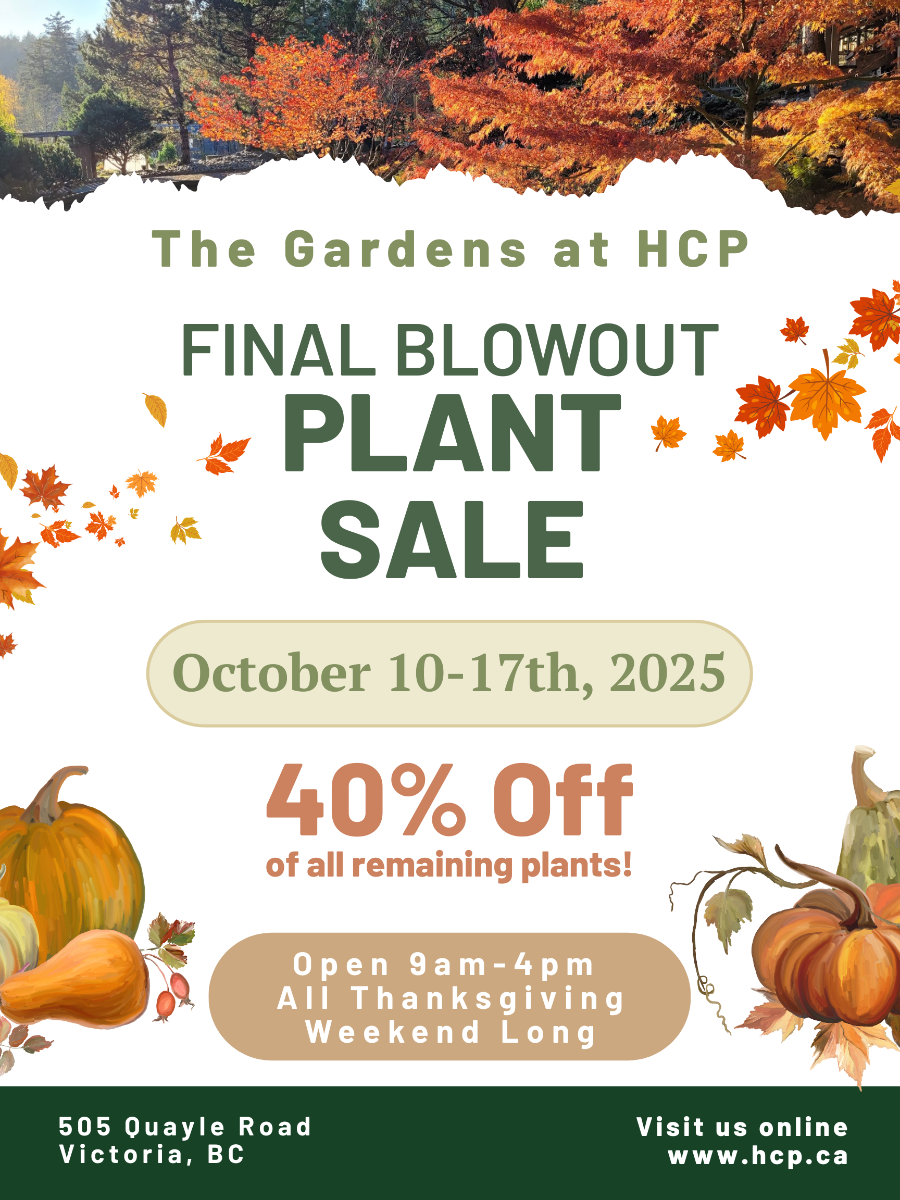
For 1 week only, October 10-17 all plants are reduced by 40%.
We have had some rain, so now is the perfect time to plant.
We still have a great selection, so don't miss our final sale of the year!
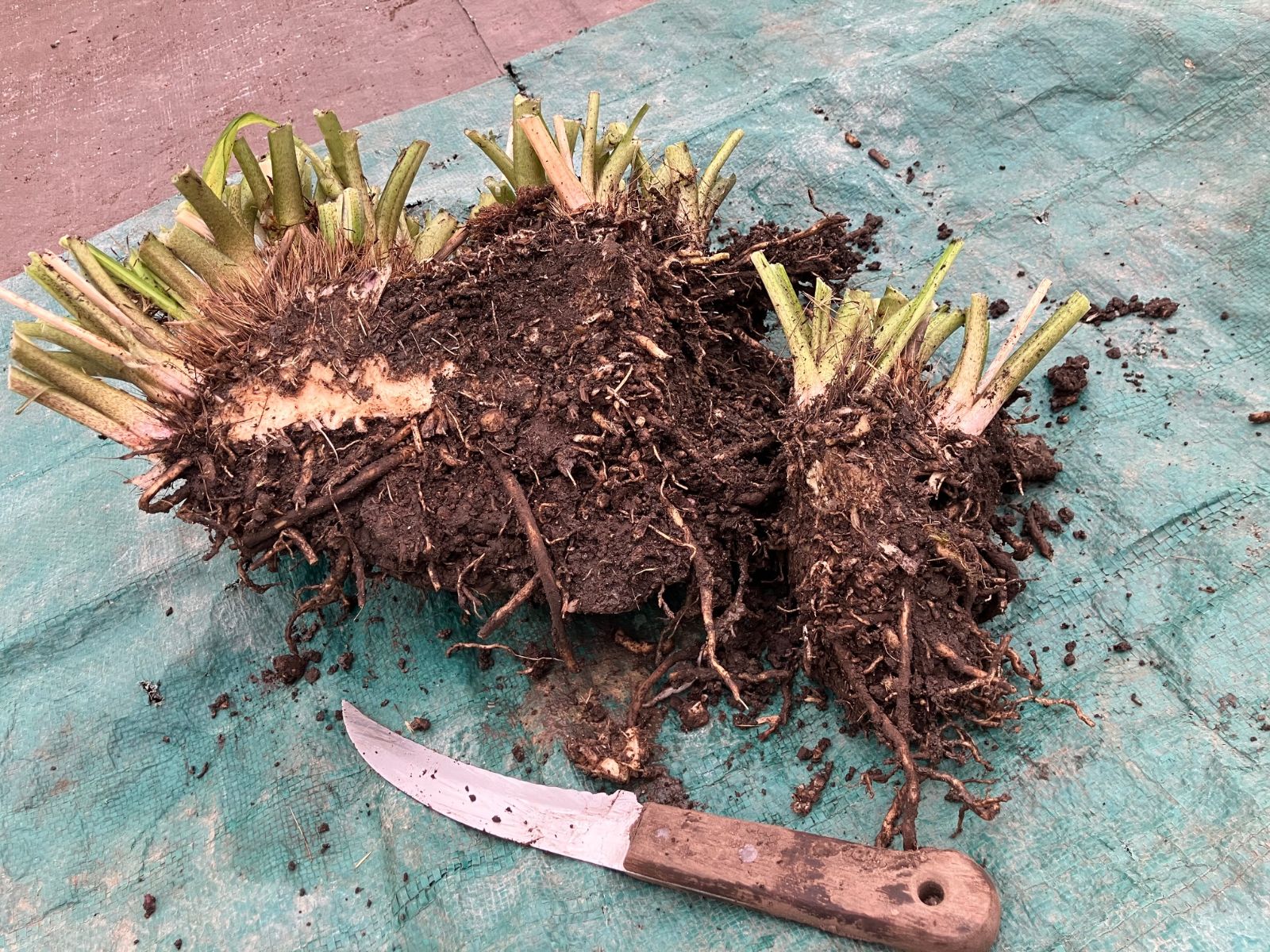
This is also a great time to divide perennials.
Do you have any overgrown perennials that you are dividing this fall? We would love it if you donated your extra clumps to HCP for us to pot up and sell at our Spring Plant Sale. Please contact me if you have any available: headgardener@hcp.ca
Please note that I need to have the proper cultivar name of the plant(s) you are donating. October-early November is the best time to divide perennials. Thank you! Linda
Takata Japanese Garden
Garden of the Month for October 2025
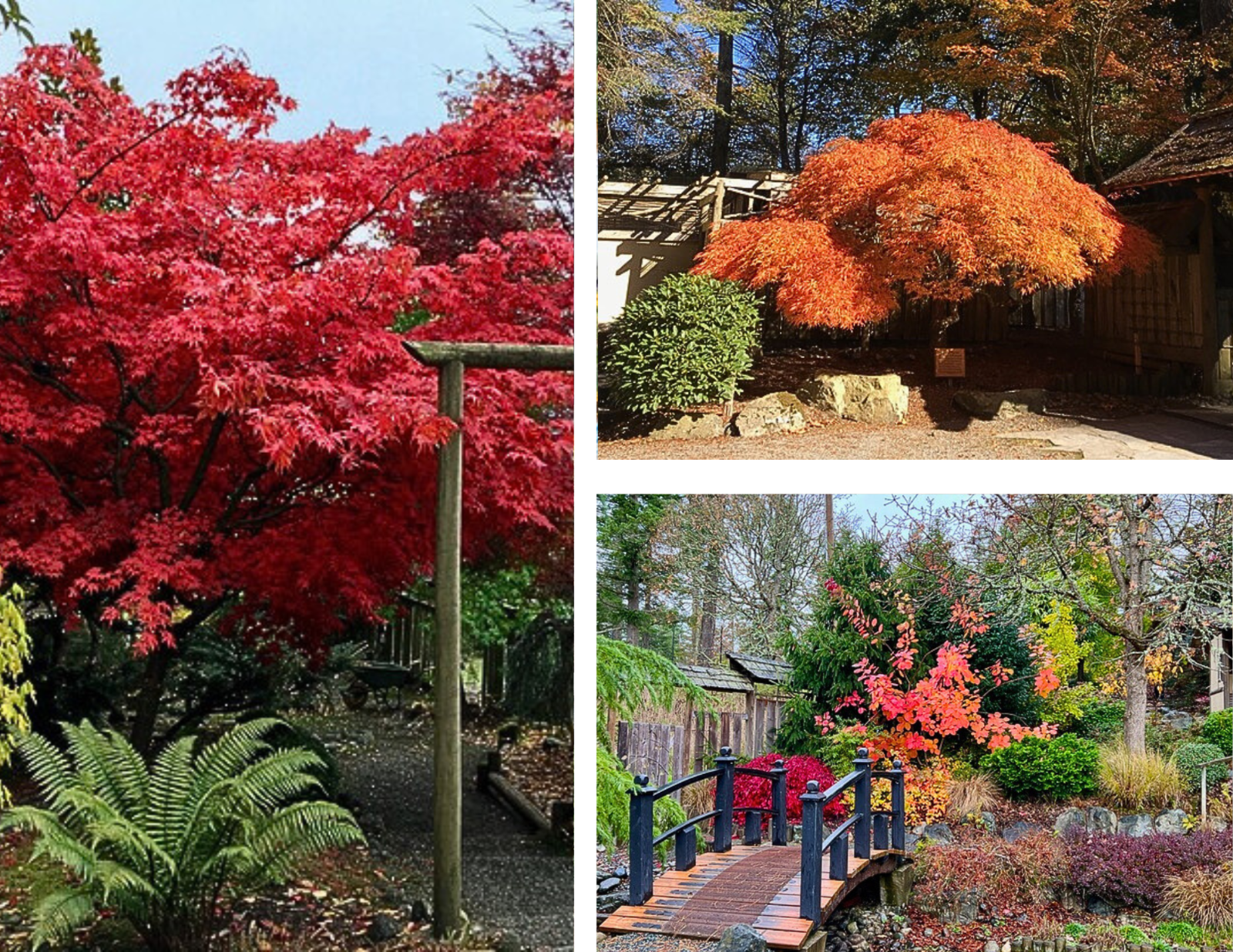
Welcome to the Takata Japanese Garden as it transitions into its Fall glory. Wander the meandering trails and take in the beauty of the stunning colours of the maples (Acer) and Ginkgo biloba trees. Pause on the Moon Bridge to listen to the stream flowing over the rocks as it makes its way through the garden or take a break on one of the many benches scattered throughout the garden.
October is visually the most spectacular month but no matter the season, the Takata Garden always offers beauty and serenity. This has been created and recently enhanced by the carefully curated vision imbued by the concept of 'Ma'.
Ma refers to the in-between, the silence, or negative space. It isn't an absence or a void, but rather it is intentionally created to bring life, balance and beauty to the picture.
It is rooted in ancient Japanese philosophy. Ma emphasizes finding beauty in the object as well as its surroundings. It helps us think about our interconnectedness and the fluid rhythm of life that evolves in spaces. It is seen in the raked gravel of the Zen Garden, the clear surface of the pond that reflects the trees, the view between branches to a hidden vista, or the space between bamboo stems.
Ma is used to create balance, an interplay between filled and unfilled spaces, that is part of a mindful scene. By focussing on the negative space, we become aware of emptiness that is filled with potential, causing us to pause and contemplate. It encourages us to slow down, unplug and engage with the environment.
Ma is present in the Takata Gardens in various elements including the lily-pad dotted pond, the sound of water in the stream, and the dry landscape of the Zen Garden. It is also apparent in how garden ornaments are placed throughout the garden, such as the stone lanterns that stand in stark contrast to the negative space around them. Bamboo fences strategically placed, guide our views, sometimes hiding, sometimes revealing. We can see the beauty of the fence but also see through it to other views.
Recently volunteers have been reimagining the old Tea House on the hillside above the Lower Pond and the renovated structure has become the Miharashidai, which is Japanese for a scenic viewpoint or overlook. A formal entrance gate with stunning artwork is nearly complete. It is indeed a beautiful place to pause your Takata Garden meanderings, inviting you inside to contemplate and become mindful of existence.
Of course, the plants are also chosen and placed with great attention to Ma principles. They are carefully pruned to have space to breathe while growing in harmony with other plants. No matter the season, each plant shows its own splendour as it transitions from blooming to fading, moving forward in our perspective for a while, then taking a back seat to others.
The garden has been thriving for years with the loving care of staff and volunteers providing visitors with a unique experience to enjoy and explore a beautiful space. The Takata Japanese Garden is named in honour of the Takata Family, whose Japanese Garden and Teahouse was a popular feature of the Esquimalt Gorge Park from 1907 to 1942.
Ref.: Understanding ‘Ma’ Or Negative Space Concepts In Japanese Garden Design
A warm welcome to our 6-week Level 3 Apprenticeship Training Program for the Pacific Horticulture College, who will begin their studies with us later this month!
And a huge Congratulations to our 2025 Certificate students, who won three first-place and four second-place ribbons for their vegetable entries at this year's Saanich Fair. We will be honouring all of their accomplishments in late November upon the completion of their program!
Future and potential Certificate students can learn more about our full-time 2026 Program, which is currently accepting applications!
Applications for our part-time 2026 Level 1 and 4 Apprenticeship Training Programs are still open. The application deadline for all of these exciting programs is December 5, 2025.
As always, mark your calendars and spread the word to those who may be interested in any of these educational opportunities! Please visit our website for more information on program dates and requirements: https://hcp.ca/pacific-horticulture-college/
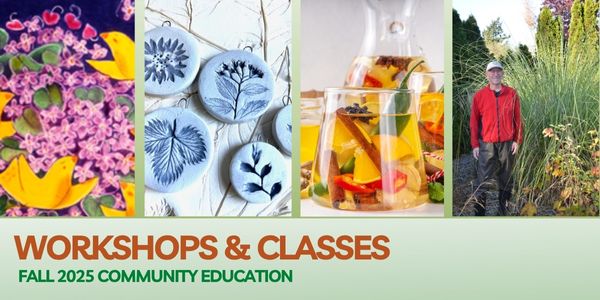
Cozy up to autumn HCP workshops and classes now open for registration. This Sunday, brew up a batch of warming fire cider or make exquisite jewelry using clay and foliage. Next week, explore artmaking with Richard Wong and Wendy Picken, or get a handle on Ornamental Grasses in your garden with Mike Rogers. Visit the Community Ed calendar to learn more and register.
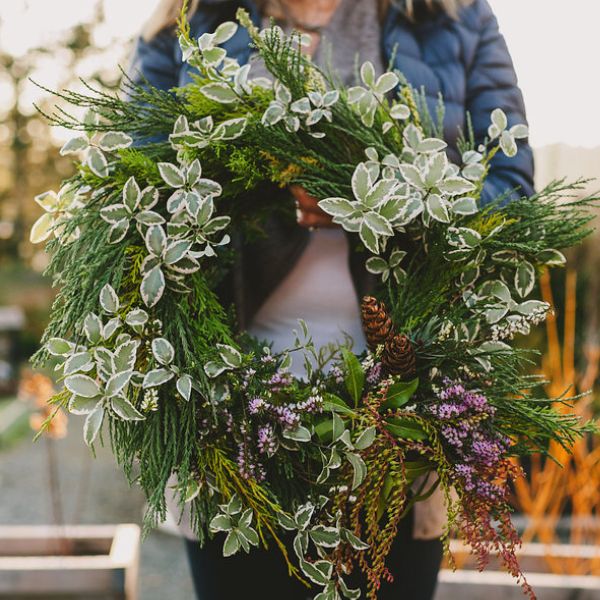
Q. When can I register for wreath making?
Adult Wreath Making workshops will open for online and phone registration on Friday, Oct. 24 at 9:00 am (in-person registration will open Oct. 25).
These popular classes, led by HCP Head Gardener Linda Petite, run Saturdays & Sundays from Nov. 22 to Dec. 7 (morning and afternoon sessions). Class size is limited to 20.
If you would like more details and advance notification including the sign-up links prior to registration, please
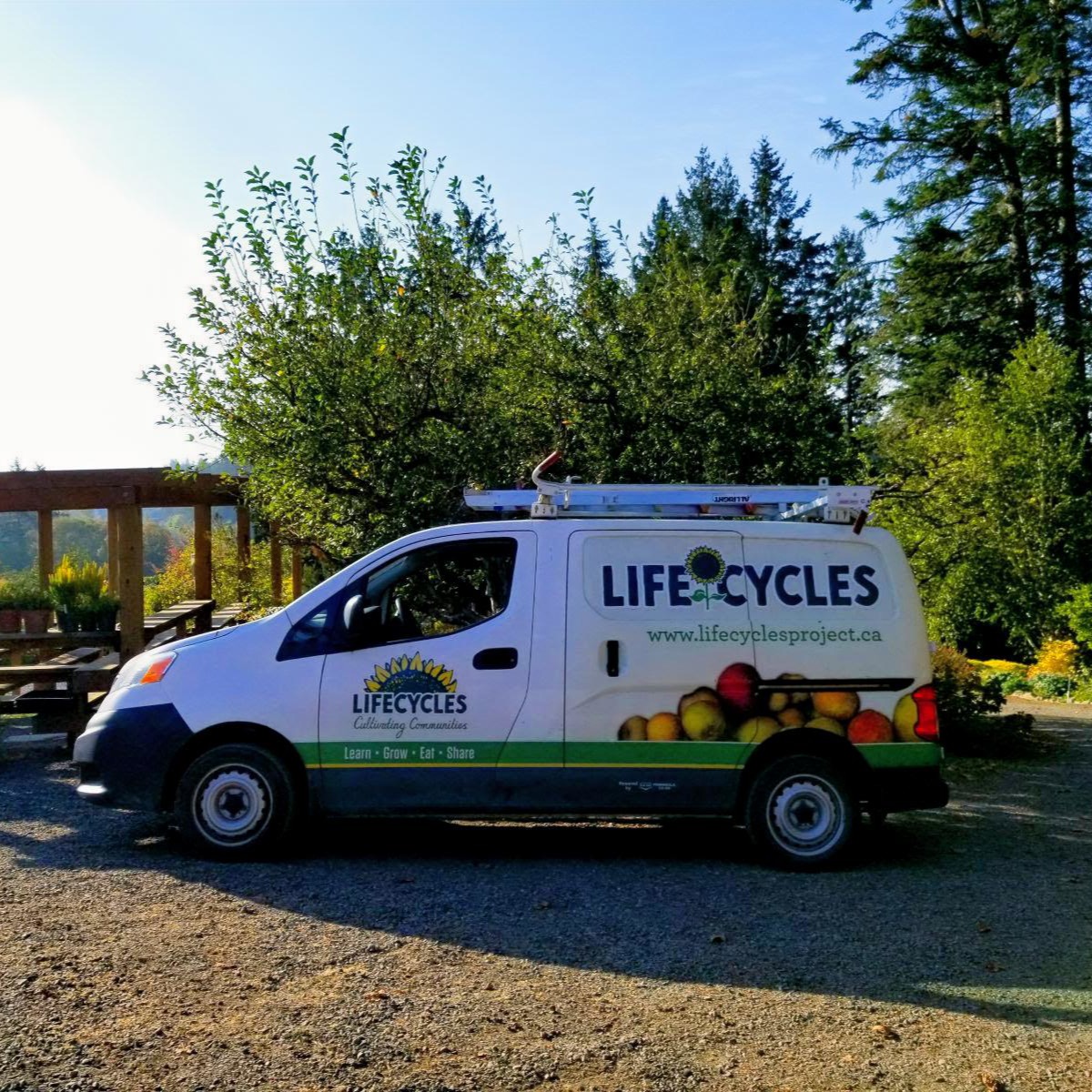
For several years, we have partnered with Lifecycles to pick the excess fruit here in the gardens.
On Sunday October 5 the Lifecycles volunteers came on site to harvest.
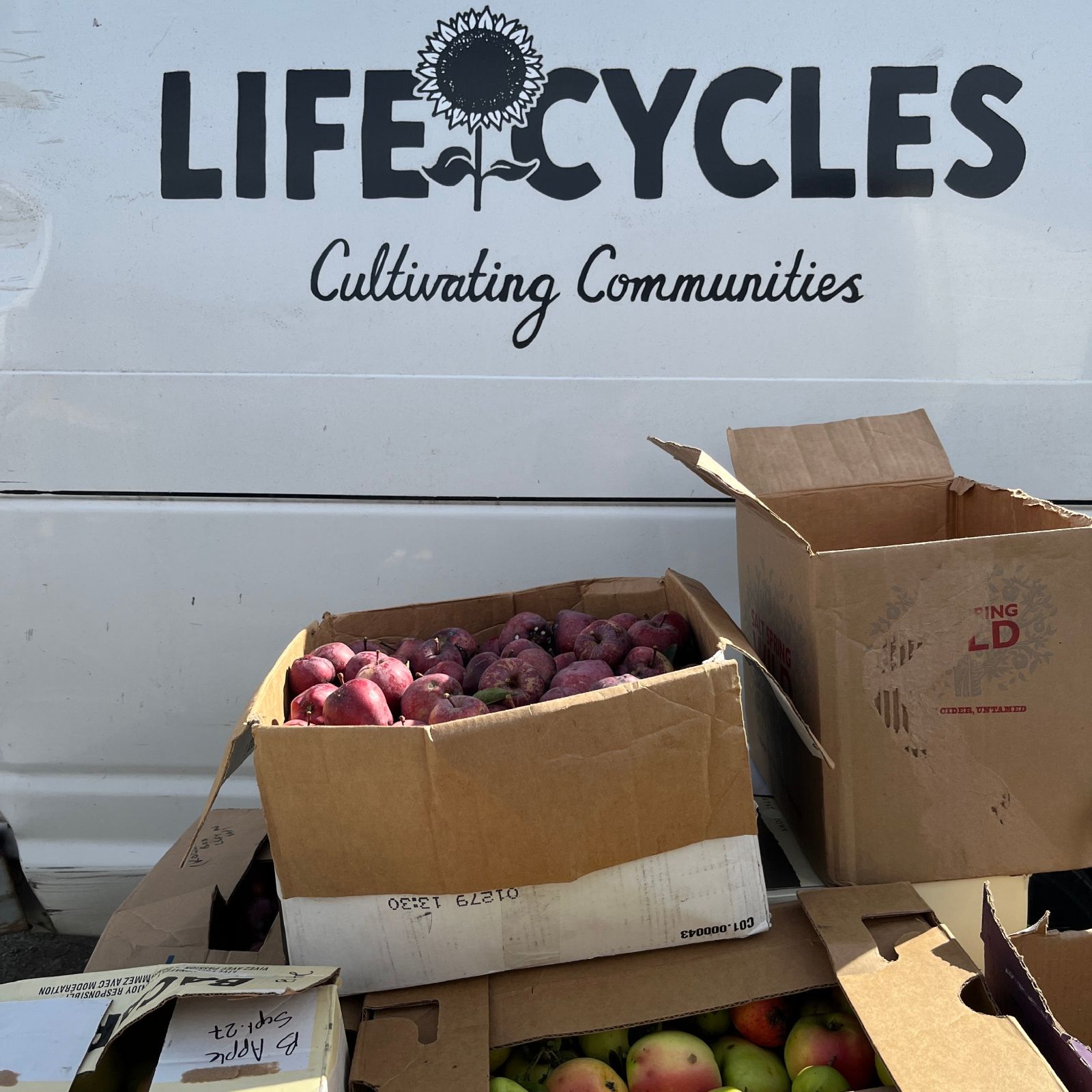
They harvested 370 lbs from the upper orchard and 294 lbs from the terrace orchard, a bumper crop this year!
In case you are wondering what actually happens to the apples once they are picked, here is the answer from their website. Find more information here.
Visit The Gardens’ Gift Shop
Next time you're at the gardens, be sure to stop by our cozy, ever-growing gift shop. Inside, you’ll find a handpicked selection of locally crafted treasures, including handmade soaps, resin earrings with real flowers, beautiful pottery, and a variety of gardening tools, books, and essentials.
Check out our Seed Sprouting Kits from Veseys. A great way to enjoy fresh greens all year long!
Garden entrance is discounted to $9 with a same-day C&Q receipt {children under 16 receive complimentary entry}.
Hours: Monday to Sunday, 9am-3pm
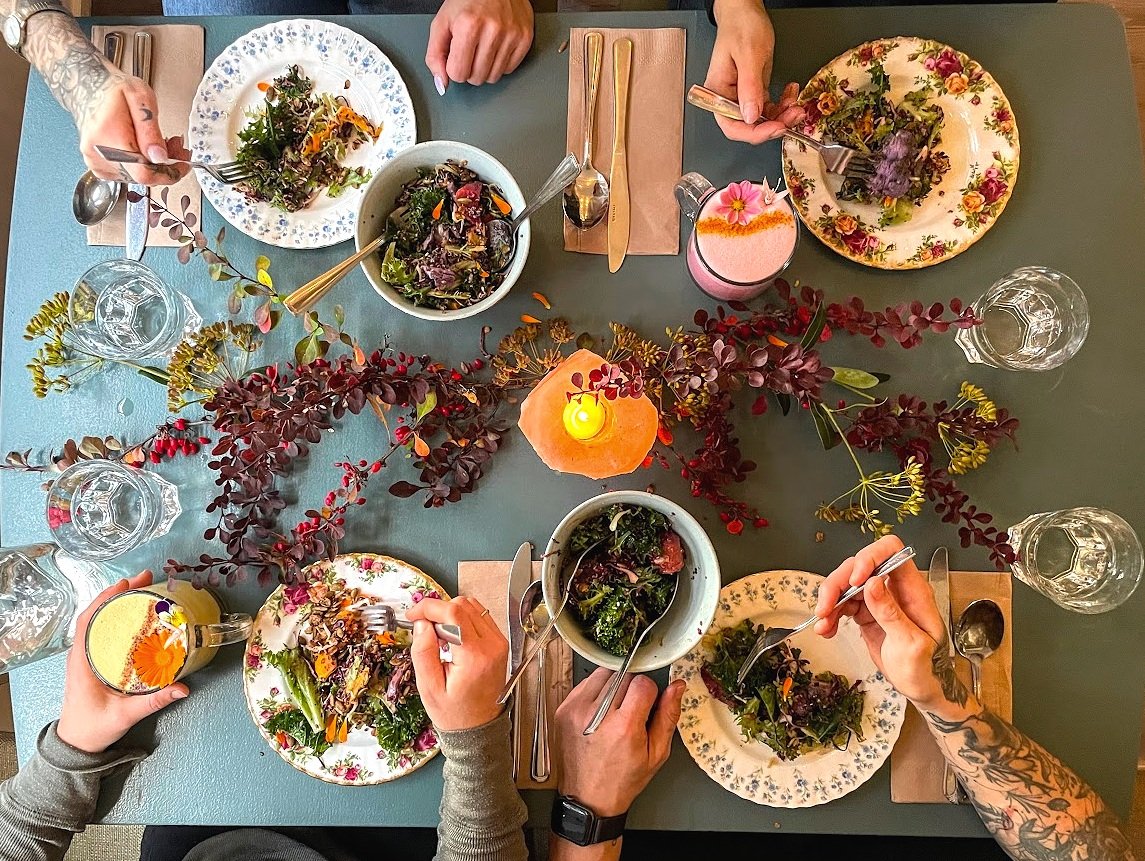
FEEL WORLDS AWAY | DINE WITH THE FLOWERS "Charlotte & The Quail" has called The Gardens home since 2010. "Our lives have forever changed with the time spent here. The Gardens have given us perspective, peace & patience. The seasons have offered us repetition, reminders & reassurance.
Library is open for browsing and borrowing Tuesday, Wednesday, Thursday & Saturday from 10 am to 1 pm. Check out the Library Catalog
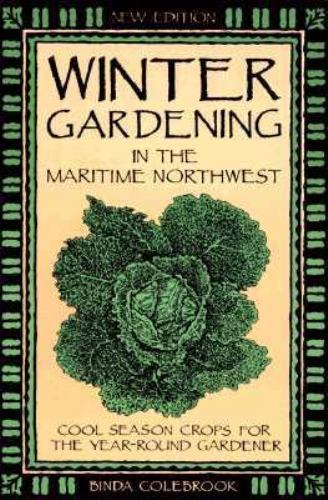
Winter Gardening in the Maritime Northwest: Cool Season Crops for the Year-Round Gardener
Binda Colebrook
SB 321 .C66 1989
Binda Colebrook was a wetlands biologist and environmental interpreter.
This author describes the cool season vegetables available to Pacific Northwest gardeners when planted at the appropriate time and by using suitable varieties.
Originally published in 1977, this book has rewarded gardeners with a ‘fresh pick’ of greens and herbs during the cooler months when seeds are planted between April and September. The selection of an appropriate growing site, what varieties to choose for hard weather and continuous harvest, how to utilize cold frames and cloches are several of her topics. Included in the book are charts for sowing and transplanting.
A chapter titled ‘Sharecroppers’ describes the pests and diseases that may thwart your harvest. Several solutions are suggested without resorting to commercial products, including cultural controls (when and how you take care of the crop), encouraging pest predators, traps, barriers and using botanical ‘poisons’. Integrated Pest Management (IPM) is the buzzword here, requiring observation to create biological controls effective for your garden.
The author provides a comprehensive list of crucifers, herbs, onions and vegetables which will survive and possibly thrive over the maritime Northwest winter.
The Appendix B ‘Winter Crops for Livestock’ includes named succulents, pasture plants and hedgerows. The extensive Appendix D provides suggestions for further reading.
This is a book for the adventuresome gardener! Have fun in the rain!
The HCP library has several books under the subject ‘Winter Gardening’ including one by our local garden expert Linda Gilkeson. Some focus on colour in the winter garden, while others are vegetable oriented.
Have any questions?
Email reception@hcp.ca or call 250-479-6162
The Gardens at HCP - 505 Quayle Road, Victoria BC, V9E 2J7
Thank you for reading, we hope you enjoyed the content. hcp.ca





.jpg)



.png)



.png)